The Myth of Freedom


For those who prefer an excellent video over reading text, just click the photo
From 1750 to 1850, American homesteaders—especially those moving westward after the Revolution—needed to acquire a range of essential goods and services to establish and maintain their farms.
While many items were produced on-site through subsistence farming, critical tools, materials, and services had to be purchased or bartered from external producers, often at great expense and logistical difficulty.
Essential Goods and Supplies
Homesteaders required a variety of physical goods to build homes, cultivate land, and sustain their families:
Farm Tools and Equipment: Plows (notably the steel-faced plow introduced by John Deere in 1838), hoes, axes, scythes, and later, improved devices like James Oliver’s “chilled plow” in the 1860s.
Livestock: Horses, oxen, cows, chickens, and pigs were essential for labor, food, and breeding.
Building Materials: Lumber, nails, glass, and hardware for constructing homes, barns, and fences. Early settlers often used sod due to lack of timber.
Household Goods: Cast-iron stoves, cookware, oil lamps, textiles, and furniture.
Seeds and Fertilizer: Necessary for crop cultivation; often had to be bought when local supplies were insufficient.
Food Staples: While many grew their own corn, beans, and wheat, items like salt, sugar, coffee, and spices were typically purchased.
Key Services and Infrastructure
In addition to tangible goods, homesteaders depended on several critical services:
Transportation: Wagons and later railroads were vital for moving supplies in and crops out. Before the expansion of rail networks, transportation was slow and costly.
Blacksmithing: Essential for repairing tools, shoeing horses, and fabricating metal parts.
Mill Services: Grain mills were needed to process corn and wheat into flour.
Banking and Credit: Farmers often borrowed money to buy land, tools, and livestock, relying on banks despite high interest rates.
Medical Care: Though often limited, some settlers paid for doctors or midwives, especially during childbirth or illness.
Who Produced These Goods and Services?
The production of these goods and services came from a mix of local artisans, emerging industries, and distant manufacturers:
Local Blacksmiths and Carpenters: Provided custom tools, repairs, and construction help within frontier communities.
Eastern and European Manufacturers: Many finished goods like stoves, textiles, and advanced farm tools were produced in industrializing regions of the Northeast or imported from Europe.
Merchants and General Stores: Acted as intermediaries, selling goods brought in via wagon trains or, later, railroads.
Banks and Financial Institutions: Mostly located in towns and cities, these provided loans and credit, though often at prohibitive rates for small farmers.
Railroad Companies: By the mid-19th century, railroads became crucial in transporting both people and goods, though they initially charged high freight rates.
Economic Challenges for Homesteaders
Despite the availability of land—especially after the Homestead Act of 1862 (just after this period)—the cost of starting a farm was steep.
It could take close to $1,000 to purchase the necessary supplies, a significant sum when most families lived hand-to-mouth.
Many would-be landowners ended up as migrant laborers, working for wages on larger farms because they couldn’t afford the startup costs.
Moreover, market forces often worked against small farmers. As more settlers produced crops, prices fell, while the cost of borrowed money and transported goods remained high.
This economic pressure contributed to the rise of large “bonanza farms” and fuelled agrarian unrest later in the century.
The image of the early American settler as a completely self-sufficient, independent yeoman is largely a myth.
While homesteaders were indeed industrious, their survival and economic viability were deeply entangled with credit networks, merchants, and market dependencies from the very beginning.
The Myth of Independence
The romanticized notion of the self-reliant pioneer obscures the reality that even the earliest settlers required capital, credit, and external goods to establish a farm.
As historian William Chauncy Langdon noted, “if you don’t bring some implements to get started, it’s not homesteading; it’s camping.” From axes and plows to seeds and cookware, essential tools had to be purchased or bartered, tying settlers immediately to a cash or credit economy.
Dependency on Credit and Merchants
Credit was the lifeblood of colonial and early American frontier economies.
Studies of merchant account books from the 18th century show that over 98% of purchases in places like Connecticut and Massachusetts were made on credit, not with cash or barter. Settlers relied on:
Book Credit: Local merchants extended credit to farmers, who paid back debts after harvest.
International Credit: Colonial merchants depended on credit from British suppliers to stock their shelves.
Crop Liens: In later decades, especially after the Civil War, merchants held legal claims on future harvests as collateral for credit.
This system meant that financial privilege—or at least access to a trustworthy merchant—was often the difference between success and failure.
High Startup Costs and Economic Barriers
Establishing a farm was expensive.
In 1843 Illinois, the cost to buy, fence, and improve just 80 acres of land was nearly $1,278, excluding the cost of livestock and tools.
Adding a pair of oxen, a wagon, and basic implements could push total startup costs well over $1,500—a prohibitive sum for most families without savings or credit.
Many would-be homesteaders could not afford these costs and instead became tenant farmers or migrant laborers, working for wages on larger estates. This economic stratification demonstrates that land ownership was not equally accessible; it favored those with capital or strong credit connections.
The Central Role of the General Store
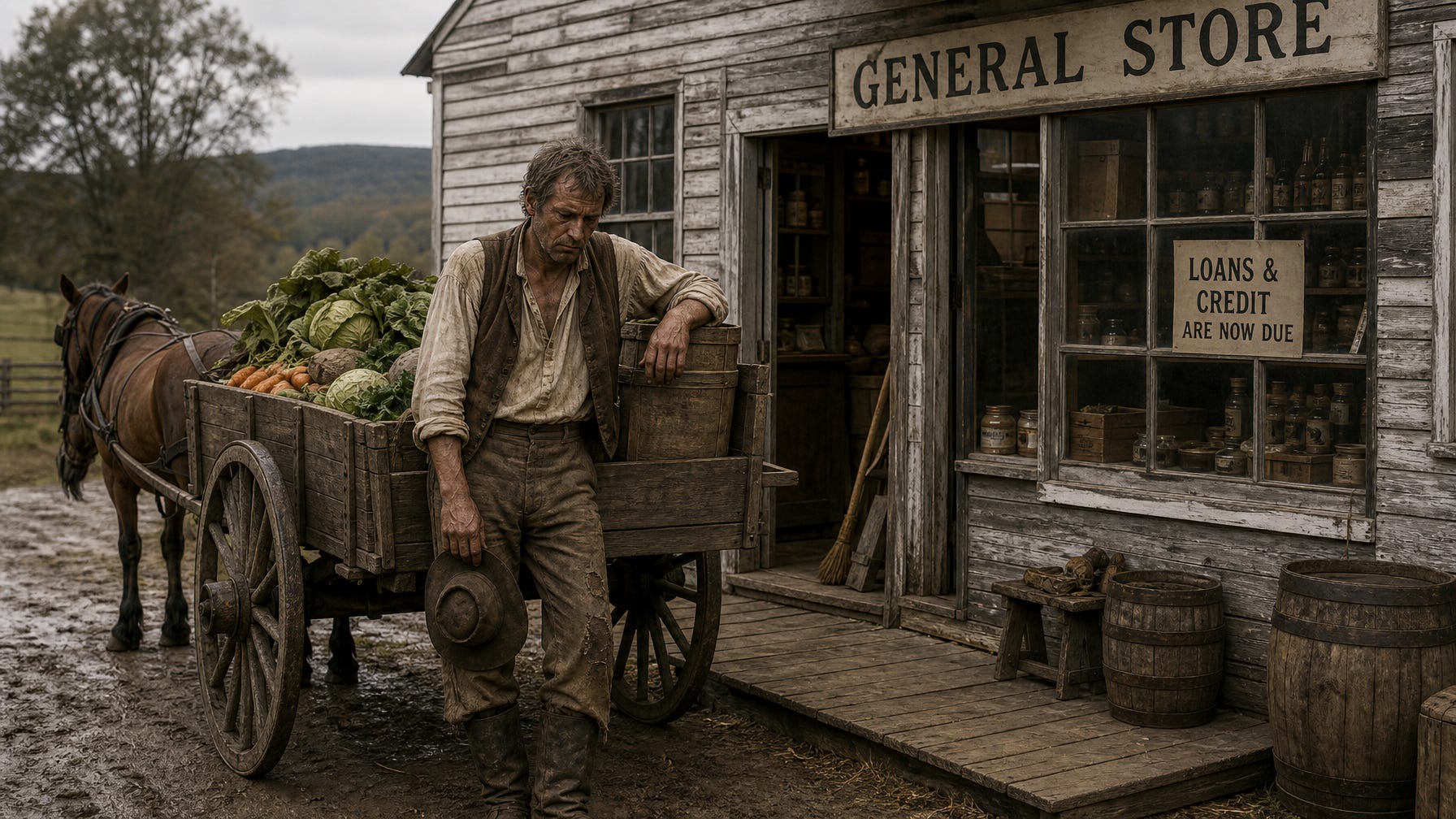
The general store was more than a shop; it was the economic and social hub of frontier life.
Storekeepers acted as:
Bankers: Extending credit and tracking debts in ledger books.
Merchants: Supplying goods that couldn’t be produced on-site (e.g., salt, coffee, nails, textiles).
Community Leaders: Mediating disputes, delivering news, and connecting isolated families to the wider world.
For many settlers, the general store was their only link to the market economy, reinforcing their dependency on external suppliers just as modern consumers rely on global supply chains.
Far from being isolated islands of self-sufficiency, early American homesteaders were deeply embedded in economic networks of credit, trade, and dependency.
Access to land and resources was heavily influenced by finance and privilege, challenging the myth of the wholly independent pioneer.
Their reality mirrors modern economic interdependence, where survival and success depend on access to capital, supply chains, and community infrastructure.
For many, the shift from feudal bondage to market dependency was a change in the mechanism of control, not necessarily the degree of freedom. While legal status changed, economic coercion often replicated the constraints of serfdom.
Economic Coercion vs. Physical Coercion
The primary distinction between the frontier and feudalism lies in the method of enforcement. Feudal serfs were bound by law and physical force; they could not leave the land without permission.
In contrast, homesteaders were legally free but bound by debt and economic necessity.
However, historians argue this distinction is often negligible in practice. The crop-lien system (prevalent post-Civil War but rooted in earlier credit practices) trapped farmers in cycles of debt where they effectively worked for merchants rather than themselves.
Like serfs, they could not leave without forfeiting their livelihood, and their labor’s value was dictated by creditors who set both the price of supplies and the value of the crop. This created a state of debt peonage, where the “freedom” to contract masked a reality of economic enslavement.
Manipulation of Labor Value
Market control over prices meant a loss of autonomy over the value of one’s labor. In a “free market” dominated by monopolies (e.g., a single general store or railroad), prices were not negotiated but dictated.
Price Fixing: Merchants often inflated the cost of goods while depressing the price paid for crops, capturing the surplus value of the farmer’s labor.
Interest as Rent: High interest rates on credit functioned similarly to feudal rent, extracting wealth from the producer without their consent to the terms.
Lack of Alternatives: With no competing buyers or sellers, the “freedom” to choose was illusory. The farmer had to accept the terms offered or starve.
This dynamic mirrors the feudal relationship where the lord controlled the mill, the oven, and the market, ensuring the peasant remained subservient regardless of their legal status.
The Illusion of Mobility
Proponents of the frontier myth argue that settlers could simply move west if conditions were unfavorable. However, this “safety valve” required capital—money for wagons, tools, and new land. For those already in debt, mobility was impossible. Just as serfs were tied to the land by law, indebted homesteaders were tied by financial obligation. The threat of foreclosure, loss of equipment, or legal action (including imprisonment for debt in earlier periods) served as a powerful deterrent to leaving, effectively binding them to their creditors
Conclusion
If freedom is defined as control over the fruits of one’s labor, then the distinction between a serf bound by law and a farmer bound by debt is indeed slim.
Both systems concentrated power in the hands of a few (lords or merchants) who dictated the terms of survival. The frontier did not eliminate hierarchy or exploitation; it merely privatized it, replacing the lord’s whip with the banker’s ledger. In this view, the “free market” was not a realm of liberty but a new architecture of control, where financial privilege replaced hereditary title as the determinant of power.
“We the People” must wake up and realize that for generations we’ve been conned and abused by an economic system that was designed to control and exploit us. True freedom and independence will only be possible if we refuse to be governed by a criminal class of financial predators.
.
Great article!
Only the lucky one's would be able to pledge their crop at full value and pay the same for their supplies that they would without credit.
I'm against hierarchy too when we're talking about an artificial, not organic, false hierarchy of manipulation, abuse, etc.
However, I'm for hierarchy when we're talking about the divine, organic and true hierarchy where on all levels of the hierarchy there is a type of equality. At the top of this hierarchy is the eternal Divine, at the bottom of the hierarchy is the temporal matter, life (all the way up to the intellectual life that humans participate in the most) is somewhere in between matter and the Divine.
A true aristocrat (an aristocrat of the soul, not to be confused with the modern definition of an aristocrat) sees value horizontally and vertically throughout the hierarchy as everything is interconnected and we depend on each other, it's like an ecosystem. The aristocrat (now I'm talking about the common definition of an aristocrat rather than the elite definition tied to the soul/spirit) sees him/herself as above the masses of men (both male and female) and treats them like crap rather than realizing that they are part of the same ecosystem and the lower part of them is not above this ecosystem but an organic part of this ecosystem just like everyone else is a part of this ecosystem and participates in it. A true leader should treat and love the masses like a parent treats and loves their children.
Even water for example, which is lower in the hierarchy perfectly participates within this hierarchy within the Divine and is like a child/offspring of the Divine and has its own role within this hierarchy. Therefore we cannot say that water is inferior, we can say that water is lower in the hierarchy, but not that it is inferior as it has its own perfect role to play within the Divine (It is well known that water is a crucial requirement for life, no water no life).
Okay, I'm done rambling about hierarchy now. :)
I'll add that there is also a difference between the common definition of liberty and the elite definition of liberty. The elite definition of liberty means freedom from tyranny, and this tyranny can come from below (like mob rule and out of control masses) or it can come from above (like a totalitarian state, a pompous and tyrannical aristocrat, feudal lord, etc).
Considering We're well past scarcity, and have tech We did not have back then, I would say We can co-create vastly better... This is a reply I gave another who asked, "How do we coordinate scarce resources while minimizing the concentration of power?"
:
First, there is no scarcity of needed resources - only artificial scarcity. When We can automate the needed work no One (or not enough of Us) wants to do, We will need to force/bribe no One to get the needed work done. And We presently can transmute elements (with lots of energy - but We can access all We need...).
100% of the cost of everything is energy. The resources sit here freely, but it takes energy/time/work/labor (all the same thing) to put them into useful configuration.
As free energy begins to flow, the cost of energy will be removed, first in the cost of production as the electricity used (and charged for in the price) will be removed. Things will be more affordable. Eventually We can do that automation of the needed work no One wants to do, because it is affordable.
The Ones displaced can look for what They love to do that helps the most, and with a focus on being rid of money, People will be more helpful. Maybe, with now what amounts to "lots of money," create charities - real charities, not like the ones We see today that put 95%+ of what They collect into the administrators' pockets - that actually help out Ones who yet struggle.
Given the amount collected by those bogus "charities" of today, where People who want to help but only have $10 or $50 to spend give the little bits to the "charities" in hopes They can make things better for Others, We can surmise that there are lots of People who would help if They can - and when the needs begin to cost little, They will help all the more.
We will have more and more time to spend helping, and being with the Ones We love.
Eventually - I'm estimating about 10 years after the free energy flows - it will be more effort than it's worth to collect the penny for [whatever - from what You produced because You love to do the production, to the house, to the... Whatever].
We will be paid in social currencies - that which You produced because You love to produce it will earn You thanks, admiration, gratitude, lauds, and so on. And obviously, half-assed efforts will be few, and will earn scorn, disgust, snubs, and other negative social currency.
But We will be free to find what We love to do that helps the most, fulfilling Our potential, following Our bliss, making Our dreams come true, without worrying about how We possibly can afford it.
As for minimizing the concentration of power... Money is the tool to power. It pays for the indoctrination that We need money, and there's no such thing as free energy tech, as only two of the myriad things They indoctrinate Us with in Their "education" system. How will bullies be paid to enforce the unEthical legalates when We all are living richly?
When We all are living richly, the only Laws there are will be Our measure. We are all responsible for arresting (or calling for help in arresting) Any who break the Laws. And that will be a rarity, given 99% of the unEthical behavior choices are made for money/profit/control.
:
It is the need for money that creates the issues We see, the artificial scarcity and all...